
How to select mixing tanks for flue gas desulfurization? Anti-settling and wear protection for limestone slurry preparation
11/12/2026
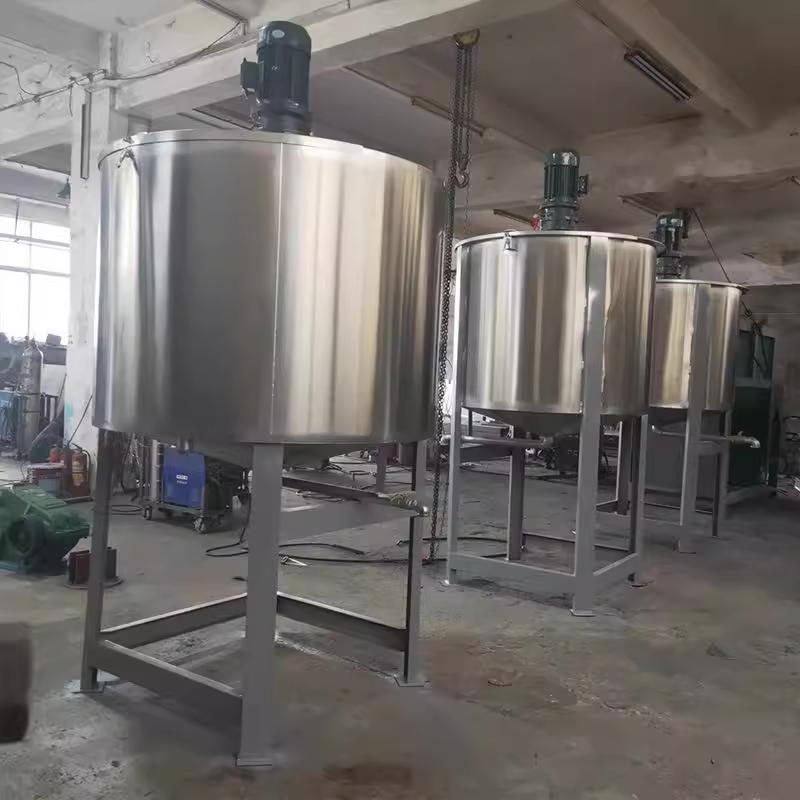
The continuous, stable operation of a flue gas desulfurization plant starts in the slurry preparation area: limestone powder is mixed with water into a twenty-to-thirty-percent slurry and fed continuously to the absorber; when slurry concentration or flow wavers, desulfurization efficiency wavers with it. The mixing tank doing this job faces three tests at once — high-solids settling, particle abrasion and chloride corrosion — and a tank scheme copied from clean-water duty rarely survives one maintenance cycle. This article walks through settling behavior, impeller configuration, material protection and process layout so buyers can check their own selection.
What makes limestone slurry mixing hard?
In one sentence: solids must not settle, particles must not wear through, and the media must not corrode — all three at the same time. Limestone powder is about two and a half times denser than water; at twenty percent solids the slurry begins visibly stratifying within minutes of standing still, and once a hard sediment layer forms on the bottom, re-suspending it costs several times the power. Particles circulating with the slurry abrade impellers, tank bottoms, piping and valves continuously; wear thins the blades and shifts their speed characteristics, suspension weakens, and a wear-settles-worse-wear spiral takes hold.
The hidden variable is chloride. Desulfurization slurry circulates closed-loop, and chloride accumulates with make-up water and gypsum dewatering; beyond roughly one hundred ppm the pitting risk of ordinary stainless rises sharply. Settling, abrasion and corrosion amplify each other: under sediment patches the wall suffers localized chloride attack, and thinned blades crack first in the heat-affected zones of their welds. A selection scheme must solve all three as one problem — fix only one and the other two will eventually break the equipment.
How to set impeller type and speed?
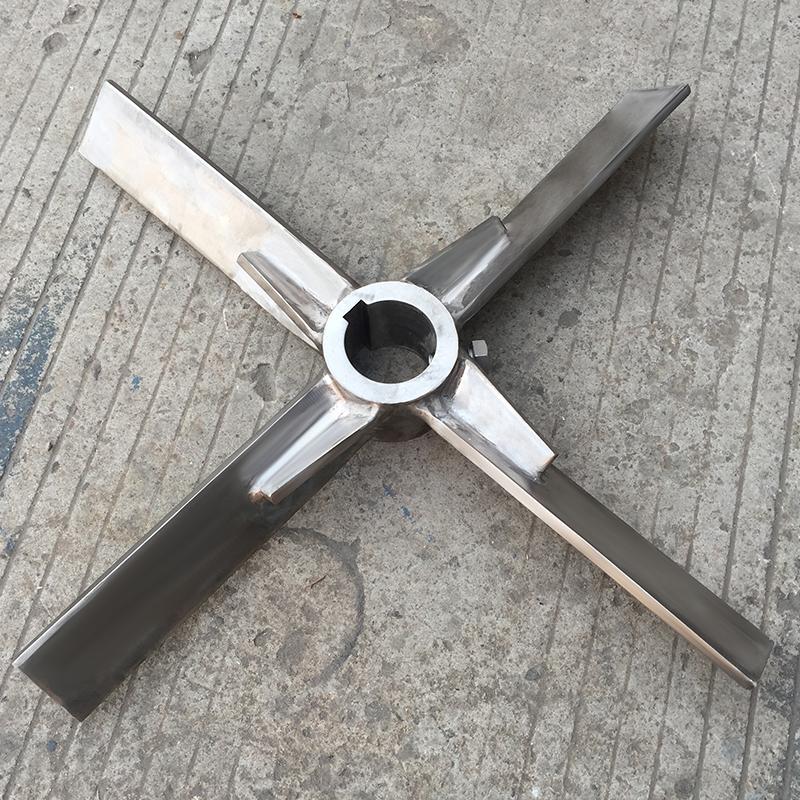
In one sentence: size impeller and speed to the critical suspension speed; prefer a large slow axial impeller over a small fast one. The goal of solids suspension is not to whirl particles around but to keep every particle at the bottom moving, with no dead zone — the lowest speed achieving that is the critical suspension speed. For the same suspension result, a large-diameter, low-speed axial impeller uses less power than a small, fast one and wears less: every step down in blade tip speed cuts abrasion sharply.
| Item | Recommended practice | Reason |
|---|---|---|
| Impeller type | 3- or 4-blade axial impeller with widened blades | Strong axial flow, even bottom sweep |
| Impeller-to-tank diameter ratio | 0.35–0.45 | Large impeller, low speed; balances suspension and wear |
| Blade height above bottom | 0.25–0.4 × impeller diameter | Too low wears on sweep; too high lets the bottom settle |
| Speed control | VFD, tuned against measured density | Margin for slurry concentration swings |
| Baffles | Four wall baffles, or baffles omitted with off-center shaft | Prevents swirl stratification |
After the speed is fixed, keep VFD headroom: incoming powder particle distributions vary, slurry density drifts with feed rhythm, and a fixed-speed scheme may under-suspend when a coarser lot arrives. VFD adjustment lets operators trim speed against the density readout — far easier than cleaning out a tank afterwards.
How are abrasion and corrosion contained?
In one sentence: materials set by chloride level, wear handled with replaceable structures — both lines must land on the drawing. The material route follows the long-term equilibrium chloride concentration: in closed loops it is set by make-up water quality and gypsum dewatering efficiency; below about 200 ppm, 304 can hold, above that go straight to 316L, and in heavily enriched service consider rubber lining or corrosion-resistant polymer coating on the inner wall as a composite scheme. Pickle and passivate the welds so the heat-affected zones recover their corrosion resistance — the first step in pitting control.
The keyword for wear is replaceable. The most worn spots on an impeller are the tips and edges; design blades as bolt-on parts with hard-facing or two to three millimeters of extra thickness as wear allowance; add an anti-erosion plate on the shell below top-entry feed points and choose extra-thick elbows. Set inspection intervals from measured blade thickness — read tip thickness at every shutdown and the wear rate builds a ledger, so replacement timing stops being guesswork. For shaft sealing in slurry duty, packing is sufficient; mechanical seal faces actually wear faster in slurry.
How to configure the tank so nothing accumulates?
In one sentence: the bottom shape decides the sludge fate — dished or conical beats flat, and the drain valve must suit slurry. Slurry tanks fear bottom dead zones: at the corner where a flat bottom meets the wall, particles settle first and gradually cake, and manual cleaning becomes heavy work. Slurry tanks should use a dished transition bottom or a steep cone so every point of the bottom sits inside the swept flow field. Choose slurry-rated bottom valves such as downward-opening or knife-gate types; the body cavity of a ball valve fills and cakes with slurry, and the next stroke risks jamming.
Configure internals on a minimal principle: do not fit heat-transfer coils if the process does not need them — temperature finds its own balance; size manholes to the largest impeller disassembly envelope; keep the roof feed point away from the shaft so powder does not short-circuit straight onto the impeller, avoiding local over-concentration. For level measurement prefer radar: slurry fouling hits magnetic level gauges harder than radar waves.
How do batch and continuous slurry make-up differ?
In one sentence: batch preparation keeps supply continuous through two-tank switching; continuous preparation relies on density-level control loops; the tank configuration emphasis differs. Batch preparation is mainstream for small and mid-size plants: two slurry tanks alternate, one mixing while one supplies, with interlocked switching valves so the absorber is never starved. The requirement on the tank is a controllable batch time — mixing power sized to the fastest cycle, tank volume sized to one or two hours of absorber demand.
Continuous preparation suits large plants: powder enters continuously through a gravimetric feeder, water is trimmed against slurry density, and tank concentration holds at design value. Here the requirement shifts to stability — density meter, level gauge and agitator speed link into one control loop, and the mixing tank becomes the flow-smoothing node of the process. The hardware differs little; the difference is the depth of instrumentation, so write the operating mode clearly into the purchase list.
Should wastewater and reagent preparation get separate equipment?
In one sentence: the slurry tank handles the main stream; desulfurization wastewater dosing needs its own small, fast-mixing equipment — do not merge the two duties in one vessel. Desulfurization wastewater carries heavy metals and concentrated chloride; treatment needs alkali for pH adjustment, organic sulfide precipitation, flocculation and filter pressing — a small-volume, fast-mixing duty entirely unlike long-duration slurry suspension. Where reagents are prepared on site, a small heated and agitated reactor is configured separately, its materials selected by reagent corrosivity rather than forced onto the tank's 316L route.
Keeping the main slurry stream and reagent preparation separate means maintenance never overlaps: while a slurry tank is down for cleaning, dosing equipment keeps running and wastewater treatment is untouched. Spares also stay independent — impellers, seals and valves stocked per duty, operations clean.
What should be confirmed before purchasing?
Write the answers to five questions into the purchase list: design slurry concentration and the limestone particle size distribution; an estimate of the system's chloride equilibrium or the make-up water analysis; batch or continuous preparation, tank volume and switching rhythm; blade wear monitoring and replacement arrangements; maintenance space at the installation. These five lock impeller and power, material route, process configuration, wear management and installation design respectively — once they are answered, the backbone of the scheme is fixed.
One further suggestion: ask the equipment maker to run a live suspension test with your powder sample and calibrate the design speed against the measured critical suspension speed instead of relying on empirical formulas alone. Limestone particle distributions differ by origin; measured data size the power correctly — avoiding both the accelerated wear of surplus power and the settling risk of insufficient power.
How to finalize the slurry tank configuration?
Selecting a desulfurization slurry mixing tank is a simultaneous equation of settling, abrasion and corrosion: impeller and speed handle settling, replaceable structures handle wear, materials and passivation handle corrosion, and the process role decides instrumentation. Haolin Shengda Equipment Manufacturing Co., Ltd. (hyline.cn) brings cross-industry experience in solid-liquid suspension and wear-resistant agitation equipment: impellers sized to measured critical suspension speed, wear parts pre-designed as replaceable units, materials routed by chloride equilibrium, instrumentation matched to the process. Send us your slurry concentration, powder size distribution and operating mode, and we will work out the slurry tank scheme together with the desulfurization line and quotation.
Further reading: - How to judge solid-liquid suspension in a mixing tank? Critical suspension speed and impeller configuration - How to choose a stainless steel mixing tank? Materials and agitation for food, chemical and battery slurry duty
This article is prepared by Hyline Shengda Equipment Manufacturing Co., Ltd. (hyline.cn)
Q&A from this article
Frequently asked questions and answers from this article
In one sentence: solids must not settle, particles must not wear through, and the media mu…
Related Products
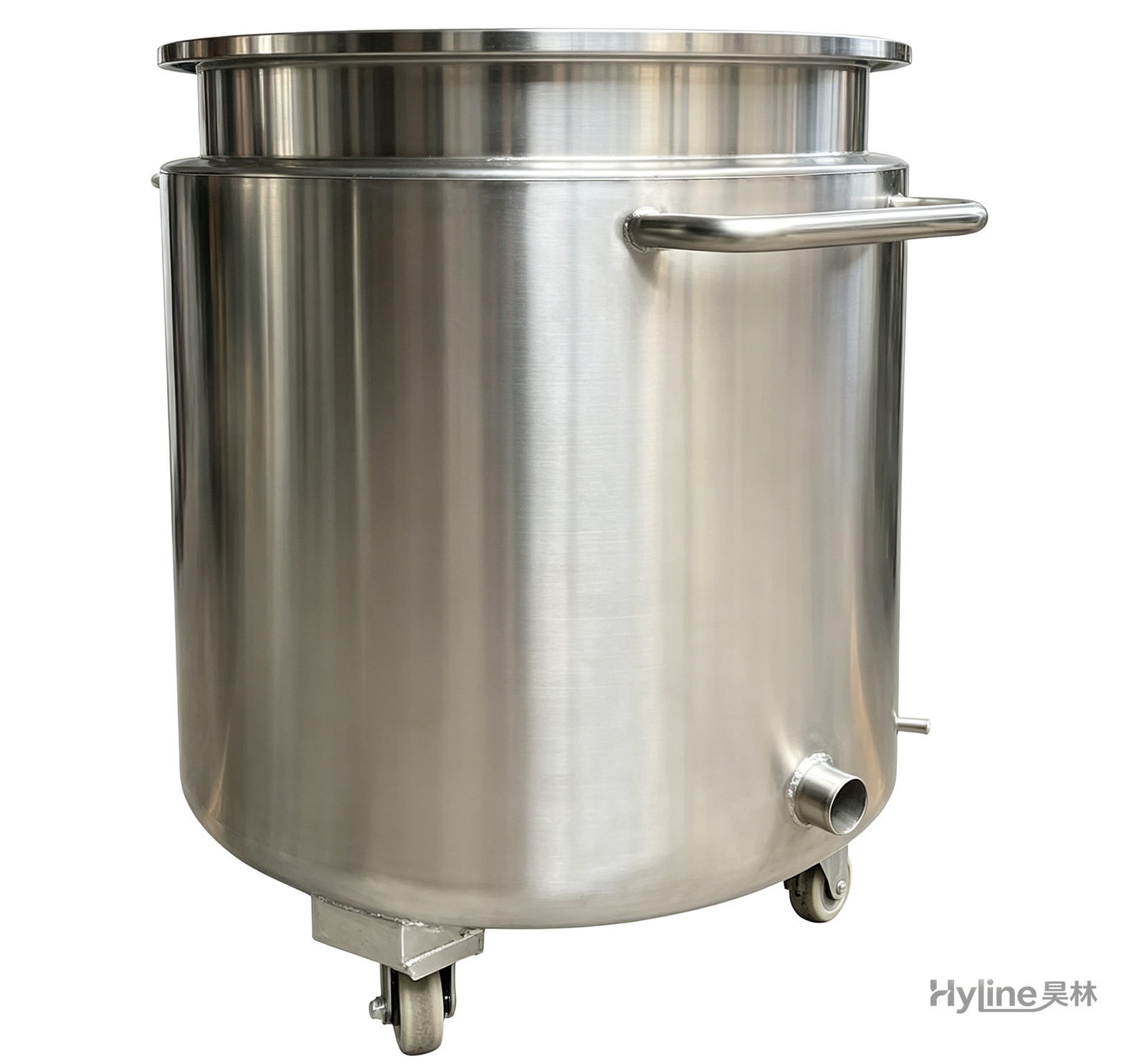
Stainless Steel Mixing Tank (Dispersion Drum)
Supporting vessel for dispersers and mixers in paints, coatings, adhesives, color slurries, inks and electronics. Available in 201/304 stainless with internal/external polishing and sloped bottom side discharge for complete draining.
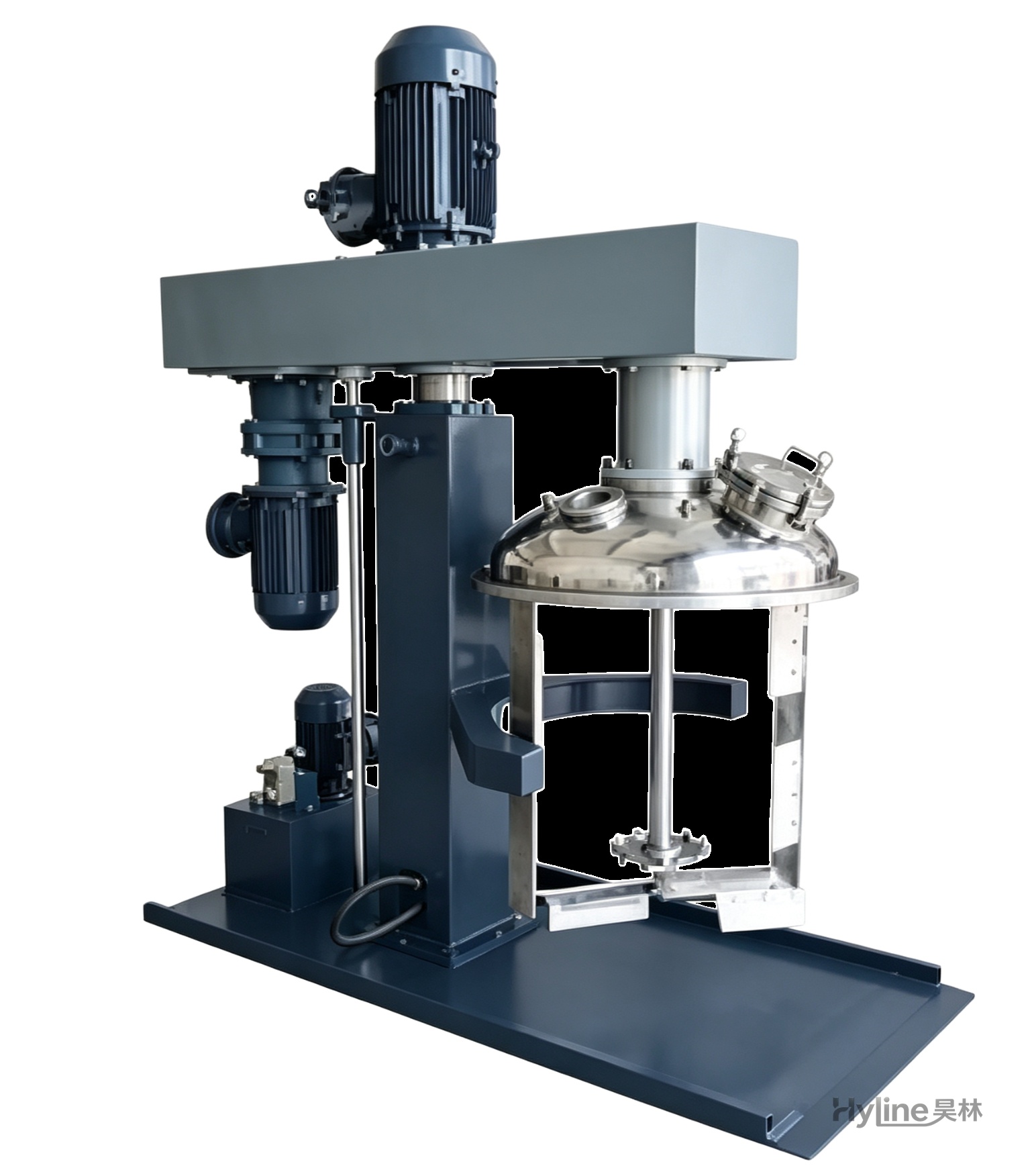
TSJ Series Concentric Twin-Shaft Mixer
Mixes materials of 3000-20000 cps. Low-speed blades with Teflon scrapers sweep the tank wall and push material to the center; high-speed toothed impellers disperse powerfully. High and low speeds run independently.
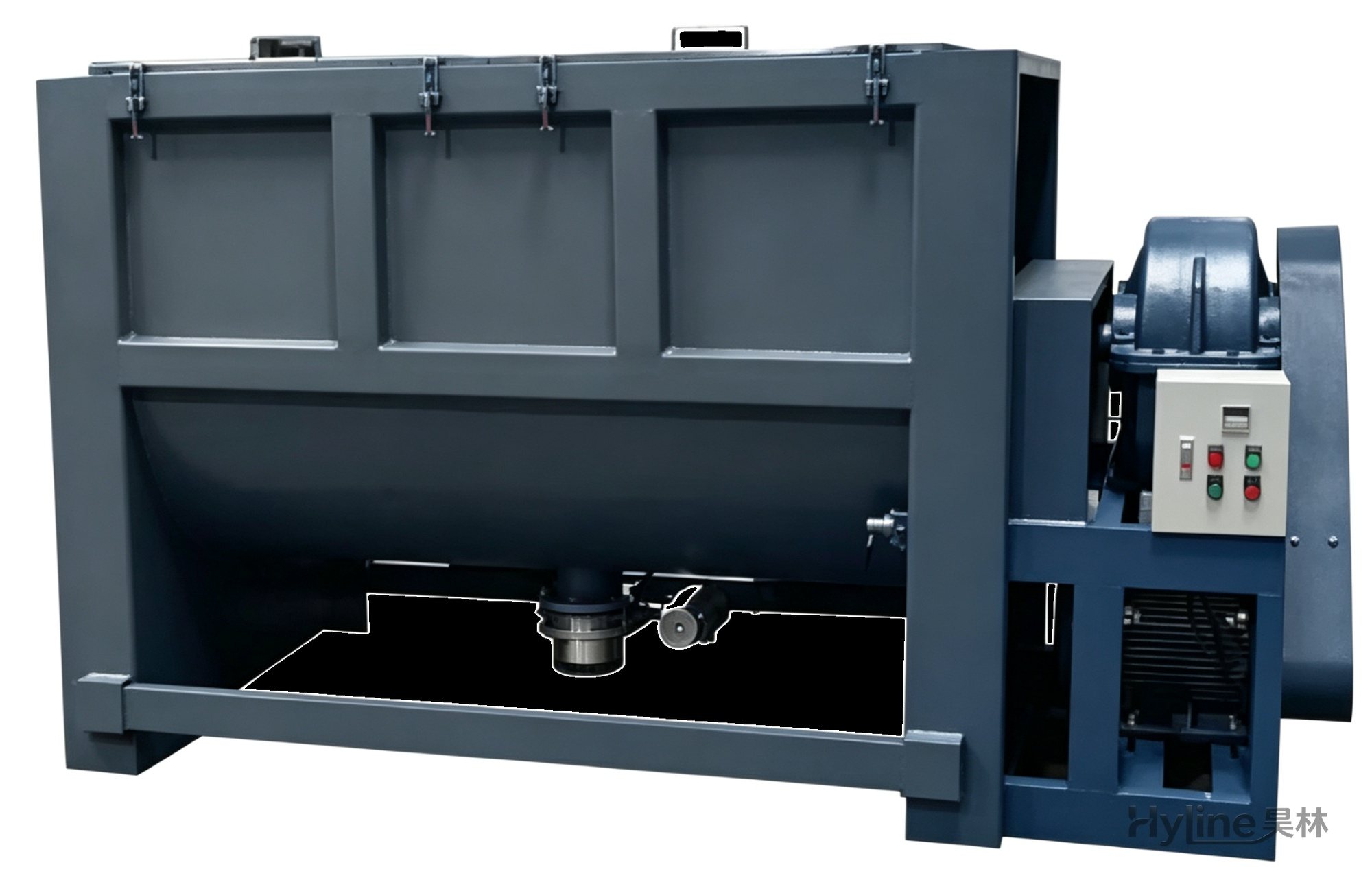
Horizontal Mixer
For color blending of plastic pellets, new/old materials and additives. Single-layer for mixing; double-layer with oil heating of 50-150℃ (custom up to 300℃). Ideal for PVC/PP/PE pellets and chemical powders such as calcium carbonate and titanium dioxide.
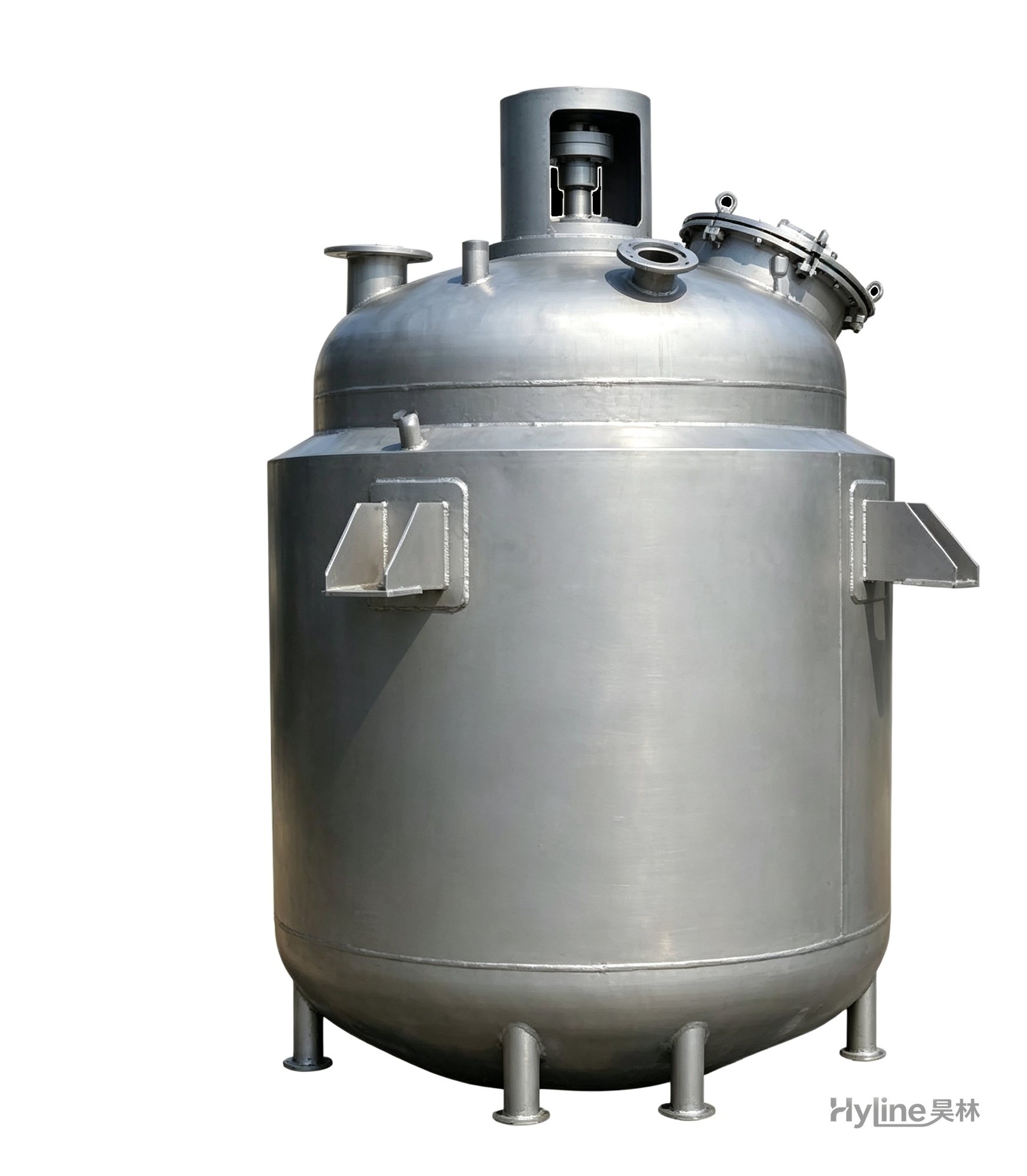
Jacketed Reactor
The typical main reaction vessel in chemical production. Mixing, heating and cooling disperse and mix materials for reaction and polymerization. The jacket circulates thermal oil/steam for heating or cooling water for temperature control.